
contact
hello@somareality.comUnlocking human potential through eye tracking
Get real-time insights into cognitive states based on eye tracking data.
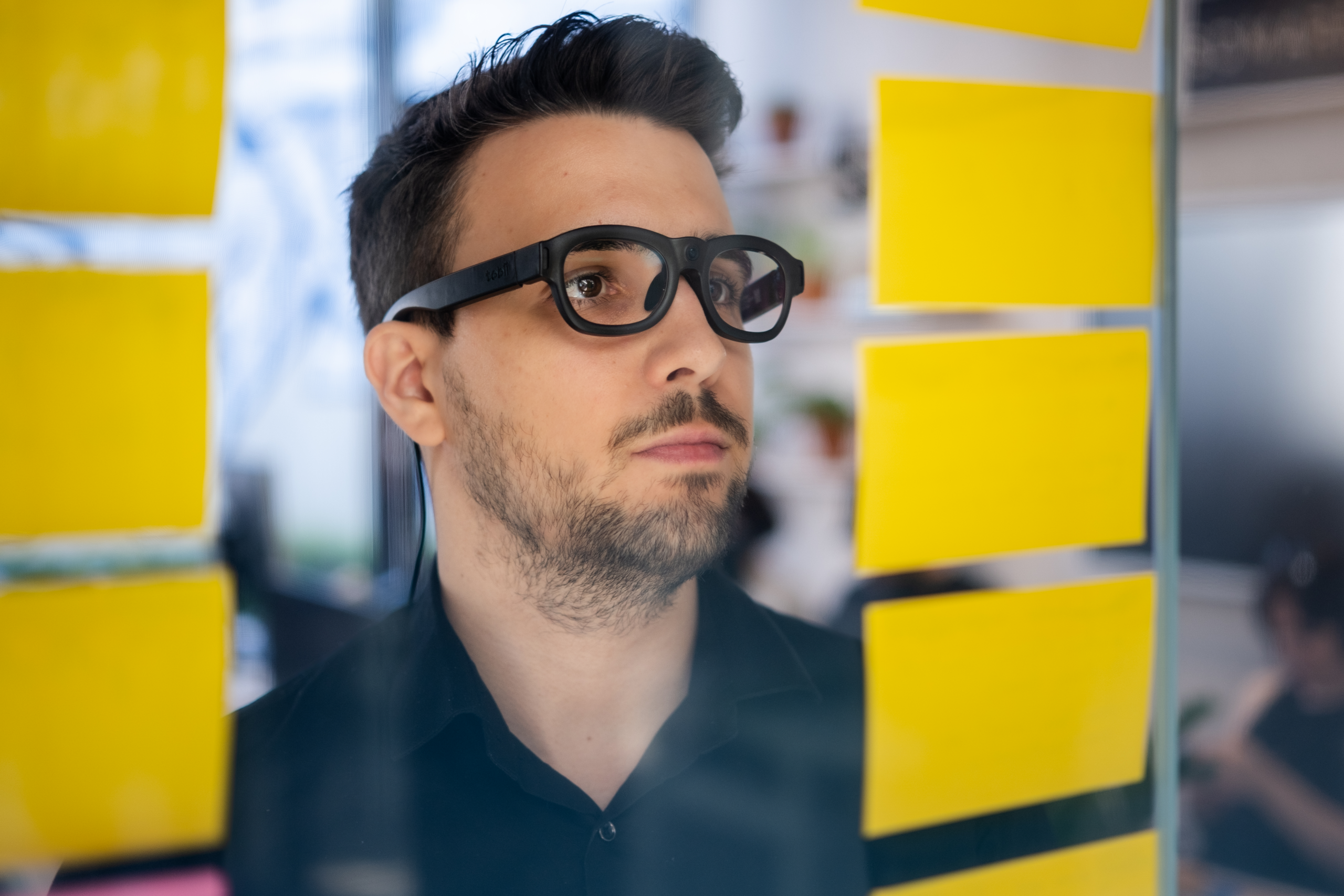
Practical benefits of this technology
Discover how SOMA’s eye tracking analytics can transform your operations, enhancing safety, productivity, and user experience.
Looking does NOT equal paying attention
At SOMA we go beyond just where people look. Our advanced cognitive biomarkers reveal deep insights into cognitive processes, offering a clear picture of mental engagement.
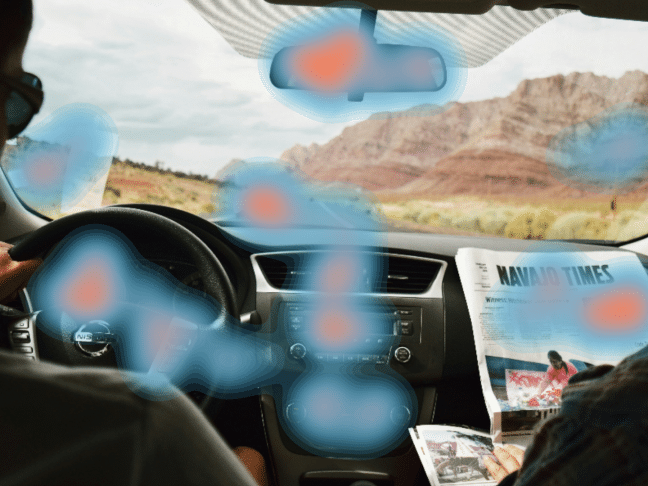
TRADITIONAL EYE TRACKING
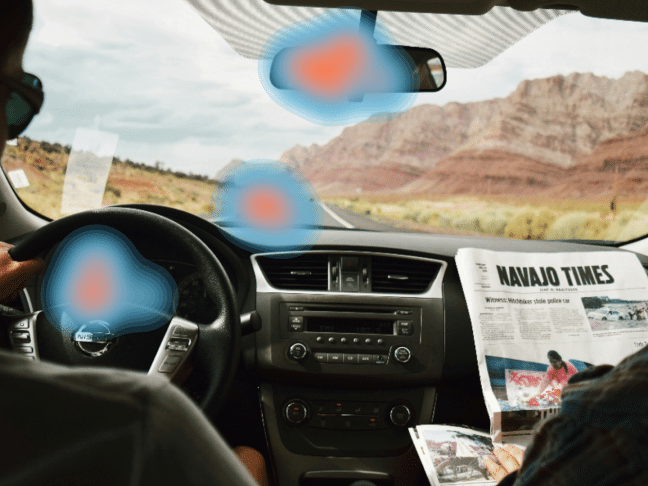
CONSCIOUS PERCEPTION HEATMAP
The Science behind
Discover how SOMA transforms eye movements into objective cognitive biomarkers backed by science and in-house validation.
Quantitative measures of Cognition
Our cutting edge algorithms are built on at least 15 years of in-house cognitive science and vision research demonstrating that eye movements provide a measurable window into human thought processes. We are a non-invasive approach, placing high value on data privacy.
A key part of our work involves pupillometry, which is highly sensitive to changes in brightness and vergence. Our core expertise lies in separating genuine cognitive signals-such as mental effort and attentional allocation-from environmental noise like lighting conditions or display luminance. By analyzing fixation duration, saccadic patterns, pupil dynamics, and visual search efficiency, we extract quantitative algorithms that directly reflect underlying cognitive functions. These algorithms are not subjective interpretations; they are derived from well-established links between oculomotor behavior and neural activity. Because gaze behavior is tightly coupled with cognition, it enables an objective, temporally precise, and real-time assessment of attention, working memory, processing speed, and executive control.
Importantly, our approach prioritizes flexibility in sampling rates and is not constrained to high-frequency data. This makes our models particularly adaptable and well-suited for integration into power-sensitive devices such as smartglasses, where energy efficiency is critical. At the base of it, using advanced statistical modeling and machine learning, we are able to transform raw eye tracking data into structured, interpretable cognitive intelligence. Our system identifies reproducible patterns associated with mental effort, attentional allocation, and perceptual engagement, but rather than relying on black-box AI, we follow a hybrid strategy that combines rule-based models with machine learning. This allows us to maintain interpretability while leveraging machine learning to enhance accuracy and robustness.
Validated in-house and peer reviewed
Scientific rigor defines our development process.
Our research team conducts systematic in-house experimentation using controlled task paradigms designed to isolate specific cognitive functions. Each algorithm is tested for sensitivity, robustness, and reproducibility across diverse conditions and participant groups. This ensures that our metrics respond accurately and predictably to changes in cognitive demand and perform reliably in real-world applications.
Overtime, we continuously refine our models using experimental datasets, benchmark comparisons, and complementary neurophysiological validation frameworks, including EEG-based paradigms. This cross-validation confirms alignment between physiological signals and established cognitive constructs.
Through this iterative process, we ensure our algorithms remain scientifically sound, technologically advanced, and grounded in empirical evidence.
Cognitive Algorithms
Individual Algorithm 1
Cognitive Load
Understanding mental effort
01
Real-time & Continuous
01
Real-time & Continuous
Enabling the objective measurement of Cognitive Load from pupillometry in real-time.
02
Compensating Brightness Changes
02
Compensating Brightness Changes
The only approach on the market that compensates for changes in environmental brightness.
01
Individual Algorithm 2
Conscious Perception Index (CPI)
Perceiving and processing information
01
Internal vs. External
01
Internal vs. External
Looking does not always mean perceiving. CPI differentiates between inward-focused thought and active engagement with the external environment.
02
Level of engagement and interaction
02
Level of engagement and interaction
CPI analyzes gaze patterns to provide interpretation of the intensity of engagement and quality of interactions.
02
Individual Algorithm 3
Attention Type Classifier (ATC)
Detecting attention levels when it oscillates
01
Breaking Down Gaze Behaviour
01
Breaking Down Gaze Behaviour
ATC evaluates fixation stability, gaze distribution, and saccadic movement to characterize visual attention patterns in real-world situations.
02
Focused vs. Switched Attention
02
Focused vs. Switched Attention
Detects whether attention is sustained on an area or dynamically shifting across the visual field.
03
Individual Algorithm 4
Cognitive Fatigue (CF)
Evaluating mental depletion over time
01
Continuous Fatigue Modeling
01
Continuous Fatigue Modeling
Quantifies Cognitive Fatigue as a continuous score, capturing subtle changes in mental endurance in real time.
02
Detecting Impact on Human Performance
02
Detecting Impact on Human Performance
Provides critical context for understanding performance variability, where fatigue can influence safety or learning outcomes
04
Individual Algorithm 5
Cognitive Performance
Understanding overall mental effectiveness
01
Multidimensional Performance Modeling
01
Multidimensional Performance Modeling
Synthesizes critical cognitive and operational variables—including cognitive load, environmental familiarity, resilience, execution precision, efficiency, and response speed—into a single, high-resolution performance index.
02
Holistic Performance Insight
02
Holistic Performance Insight
Delivers a unified metric that reveals how individuals perform under varying levels of demand, enabling objective evaluation across training, operational, and real-world environments.
05
Easy setup from the get go
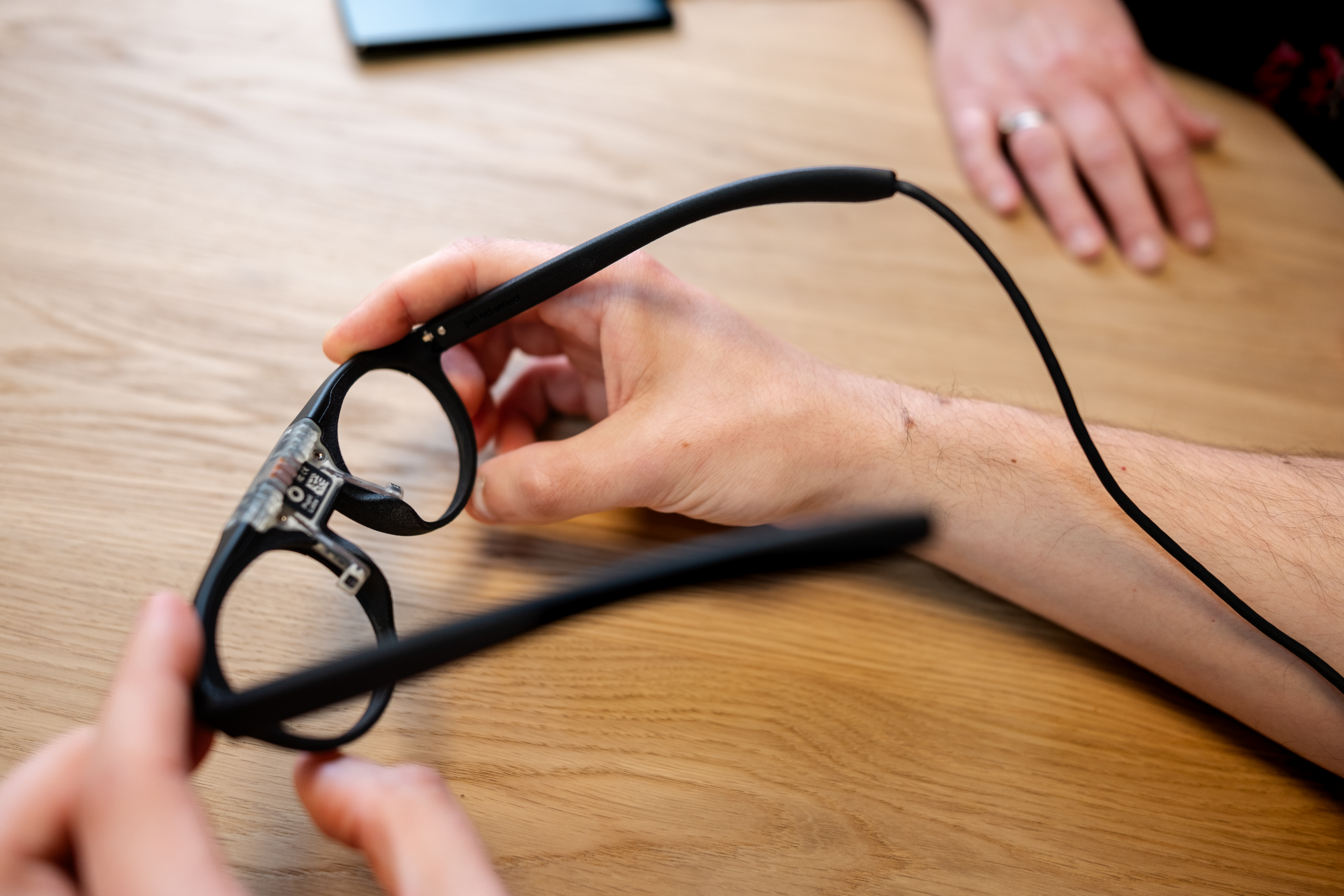
Our eye tracking system is designed for simplicity. Quick to set up, intuitive to use and easy to understand. It integrates seamlessly into your existing processes.
01
Choose your hardware
Use your preferred eye tracking device. Our software is hardware-agnostic and compatible with well-established eye trackers on the market, allowing you to select the setup that best fits your environment and application.

02
Calibrate & Record
Pair your device with our software and calibrate the user in under 2 minutes to establish a reliable baseline. Calibration is fast and guided through short setup tasks, ensuring accurate data collection with minimal preparation time.

03
Upload & Analyze
Launch the SOMA Aware dashboard, upload your eye tracking video and data, and process your session to generate cognitive results. The platform visualizes cognitive load, perception, attention, and fatigue metrics, ready for export and integration into your workflow.
Scientific Publications
We are continuously deepening and validating the measurement of human cognition via publications in recognized academic journals and attendance at international conferences.
Find more insights in our whitepapers
Explore our comprehensive whitepapers to dive deep into the future of cognitive monitoring and eye tracking analytics.
Download our whitepapersQuestions?
Find quick answers to some of the most common questions about SOMA’s eye-tracking technology, applications, and how it can revolutionize your cognitive insights.
What hardware do I need to run SOMA algorithms?
We build all our algorithms both device and context agnostic. Any device that produces eye tracking data (gaze, pupil dilation, first person video or screen brightness) can be made to be compatible with our software. We currently offer full support for the following:
Tobii Glasses Pro 2/3
Tobii Glasses X
Tobii remote eye tracker suite (coming soon)
Pupil Neon
Pupil Core
What is your pricing model?
We offer monthly, annual, and perpetual license plans for individual and bundled algorithms, depending on your use case and needs. Our Dashboard can run and process either fully on-premise or cloud-based (coming soon). For the full pricing list and a concrete offer please contact us.
Are there any materials to support the validity of your algorithms?
Yes, please email us to receive the full publication list, EEG whitepapers and patent information. You can also find more detailed information on validation and the scientific underpinning in our whitepapers.
How is data processed with your algorithms?
You can access our cognitive algorithms on the SOMA Aware Dashboard. All you need is the scene video and gaze data file. Upon uploading, you will receive cognitive statistics, graphs, and raw scores.
Do your algorithms work realtime or post-processing?
Both are possible on the SOMA Aware Dashboard and in your custom solution.
Do you work with VR Systems?
We do offer our algorithms for selected VR headsets. Since this area usually comes with custom integration effort, please send us a project brief detailing your hardware and software specs.
Do you manufacture eye tracking glasses?
No, but we work in close partnership with the leading eye tracking manufacturers in Europe.
How to work with us
01
Contact us via contact form
Reach out to us and we’ll get back to you to discuss your specific needs and how we can help.
02
Define your needs
We’ll work closely with you to understand your goals and customize a solution that fits your requirements.
03
Implement the solution
Once everything is aligned, our team will assist in seamlessly integrating our technology into your operations.