Towards Cognitive Health Analytics based on Eye Tracking
SOMAREALITY
Measuring Cognitive Health with Eye Tracking
The past decade has seen rapid advances in wearable sensing technologies that have transformed how physical health is monitored outside clinical settings. Modern smartwatches and fitness trackers continuously measure physiological signals such as heart rate, heart rate variability, respiration, and movement, enabling the extraction of digital biomarkers that provide valuable insight into cardiovascular fitness, sleep quality, stress, and overall physical well-being. These devices demonstrate that continuous passive sensing can complement traditional clinical assessments by capturing health as it unfolds in everyday life.
Despite these advances, the ability to continuously assess cognitive health remains comparatively limited. Cognitive function is typically evaluated using structured neuropsychological tests administered intermittently in clinical or laboratory environments, providing only sparse snapshots of an individual’s cognitive state. Because cognitive health plays a central role in productivity, learning, aging, mental health, and the early detection of neurological disorders, there is a growing need for digital biomarkers that monitor cognitive function unobtrusively and at scale in natural environments.
Eye movements represent a compelling candidate for this next generation of wearable biomarkers. The human oculomotor system is tightly coupled with attention, working memory, executive control, decision-making, and other higher-order cognitive processes. Advances in lightweight, wearable eye-tracking technology now make it possible to continuously measure these behaviors during everyday activities with high temporal precision. As eye tracking integrates increasingly into consumer devices such as augmented and mixed reality headsets, it offers the potential to establish wearable sensing for cognitive health in much the same way cardiac sensing transformed physical health monitoring.
Approach
Digital biomarkers derived from eye-tracking data offer a promising, non-invasive approach to investigating subtle variations in cognitive health in everyday settings. The study design was developed in close collaboration with cognitive assessment specialists at Hogrefe, a leading publisher and developer of scientifically validated psychological assessments. For over 75 years, Hogrefe has developed, standardized, and validated instruments widely used in clinical practice and research, ensuring that the cognitive assessment protocol followed established scientific standards and represented validated measures of executive functioning and working memory.
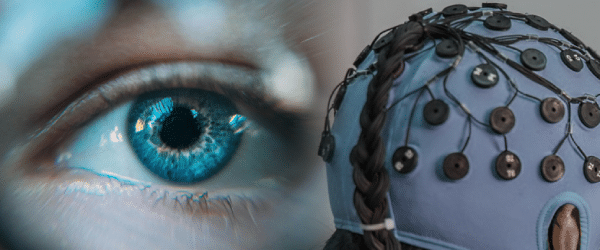
Over the course of one month, 29 participants visited the laboratory at the Medical University of Vienna once a week. During each visit, participants wore mobile eye-tracking glasses for four hours while engaging in naturalistic activities, including playing board games, reading, and socializing. Cognitive performance was assessed twice during each session (at the beginning and end, yielding eight time points overall) using the Wisconsin Card Sorting Task, the Counting Span Task, and the d2-R task. These are well-established measures of cognitive flexibility, executive function, working memory capacity, and concentration performance, with the d2-R specifically validated by Hogrefe.
Gaze features were computed for all four-hour recording sessions over the four-week study period, capturing variations in visual exploration strategy—specifically the balance between ambient and focal viewing—as well as visuomotor targeting precision during naturalistic behaviors. Exploration strategy reflects how individuals sample visual information over time, with ambient viewing indicating broader scanning and focal viewing indicating localized, detail-oriented processing. Saccadic targeting precision is sensitive to executive function, inhibitory control, frontal circuitry, and general oculomotor slowing. All features are context agnostic and require no scene video context.
Features were correlated with results across three cognitive domains: cognitive flexibility from the Wisconsin Card Sorting Test, working memory from the Counting Span Task, and selective attention from the d2-R concentration-performance score. A three-factor latent-variable model was constructed hierarchically using participant-specific effects, centered time point effects, and domain-specific within- and between-person feature effects.
Insights and Results
Results revealed that cognitive flexibility and selective attention were most strongly correlated with targeting precision, while working memory capacity was most strongly correlated with exploration strategy. Visuomotor targeting precision tended to decrease from the beginning to the end of a recording day, and participants showed a strong learning effect for the d2-R test over the longitudinal setup.
The hierarchical model explained a substantial proportion of variance across all three cognitive domains, with the highest Bayesian R-squared for selective attention, followed by working memory and cognitive flexibility. Estimated cognitive health across the domains varied over time, capturing the d2-R training effect as well as gradual improvements with minor fluctuations in cognitive flexibility and working memory.
At the within-person level, higher-than-usual targeting precision was positively associated with cognitive flexibility, and higher-than-usual ambient exploration was positively associated with working memory. Participants showed better cognitive health at time points when visuomotor control was more precise than usual and exploration was more ambient. At the between-person level, credible intervals crossed zero, indicating insufficient evidence for consistent differences between participants with generally higher versus lower gaze-feature values.
Cognitive Health Model & B2B Vision
Latent cognitive health can be meaningfully estimated from cognitive test outcomes and exhibits substantial individual differences over a study period. Eye-tracking features related to visuomotor targeting precision and exploration strategy show strong associations with latent cognitive health, particularly at the within-person level. With further research, naturalistic eye-tracking models could support early identification of subtle cognitive changes and complement existing approaches for assessing cognitive decline.
As eye tracking becomes an integral component of everyday computing platforms—including augmented and mixed reality headsets, smart glasses, and future human-computer interfaces—it will evolve from a specialized research tool into an always-on sensing modality embedded in daily life. Just as heart rate sensing transformed physical health monitoring, continuous passive cognitive monitoring opens significant opportunities for business applications, workforce safety, personalized learning, real-time adaptation, and early healthcare detection.